News
Was the only survivor in the recent Air India crash arrested?


It was one of the worst aviation disasters in recent Indian history.

An Air India Dreamliner crashed shortly after takeoff on June 12, 2025, from Ahmedabad, Gujarat, killing over 270 people. The world mourned. Families grieved. News outlets ran 24-hour coverage. And then, about a week later, another story began to surface online.
This time, it wasn’t about tragedy. It was about deception.
A video posted by an Instagram account named @aviationspotting7 claimed that the crash’s lone survivor, a man named Vishwas Ramesh Kumar, had been arrested for faking his presence on the flight.

The voiceover was calm but accusing. It claimed that Kumar was nowhere on the passenger manifest, He had been caught on CCTV at a local shopping mall during the time of the crash, and had lied to gain compensation or media attention.
The caption was damning:
“Truth revealed: Survivor of Air India crash arrested for falsely claiming to be on board.”
The video was shared widely on Instagram and WhatsApp. Hashtags like #TruthRevealed, #AirIndiaCrash, and #FakeSurvivor added fuel.
People were outraged. They accused Kumar of exploiting the deaths of 270 people. Some demanded he be jailed. Others doubted there had been any survivor at all.

But let’s pause. Because there’s a problem with this story.
Actually, several.
First, no credible Indian news outlet reported Kumar’s arrest. That’s unusual, especially given the intense local and international coverage surrounding the crash.
Second, when journalists reached out directly to law enforcement, they got a very different account.
Jaipal Singh Rathore, Additional Commissioner of Police in Ahmedabad, was unequivocal:
“Mr. Vishwas Ramesh Kumar has not been arrested. He is not under investigation for any such claim.”
In fact, police confirmed that Kumar was onboard the doomed flight. He survived—barely—and was treated at Ahmedabad Civil Hospital for multiple injuries.

So why the confusion?
Investigators believe Kumar’s survival was due to sheer luck—and seat location. He was seated near an emergency exit, which may have allowed him to escape during the crash’s brief but devastating window.
Following his discharge, Kumar even attended the funeral rites of his brother — one of the victims who perished in the crash. Photos showed him visibly shaken, standing beside grieving relatives.
None of this matches the image painted in the viral video.
So where did that narrative come from?
While it’s unclear who produced the false video, analysts point to a growing trend of AI-generated disinformation. With just a few clips, stock footage, and a synthesized voiceover, anyone can manufacture an alternate reality — one that looks real and spreads fast.
But the damage is also real.
Kumar, already a survivor of a traumatic event, had his name dragged through the mud. He was accused, insulted, and questioned — not for what he did, but for what someone said he did.
The verdict: The claim is FALSE. Kumar was not arrested. He survived the crash. He never lied.
What happened to him was not fraud. It was survival.
And once again, the internet proved that a lie told well can still outrun the truth — unless someone stops to check.
That’s what we do here at WABMA Debunker.
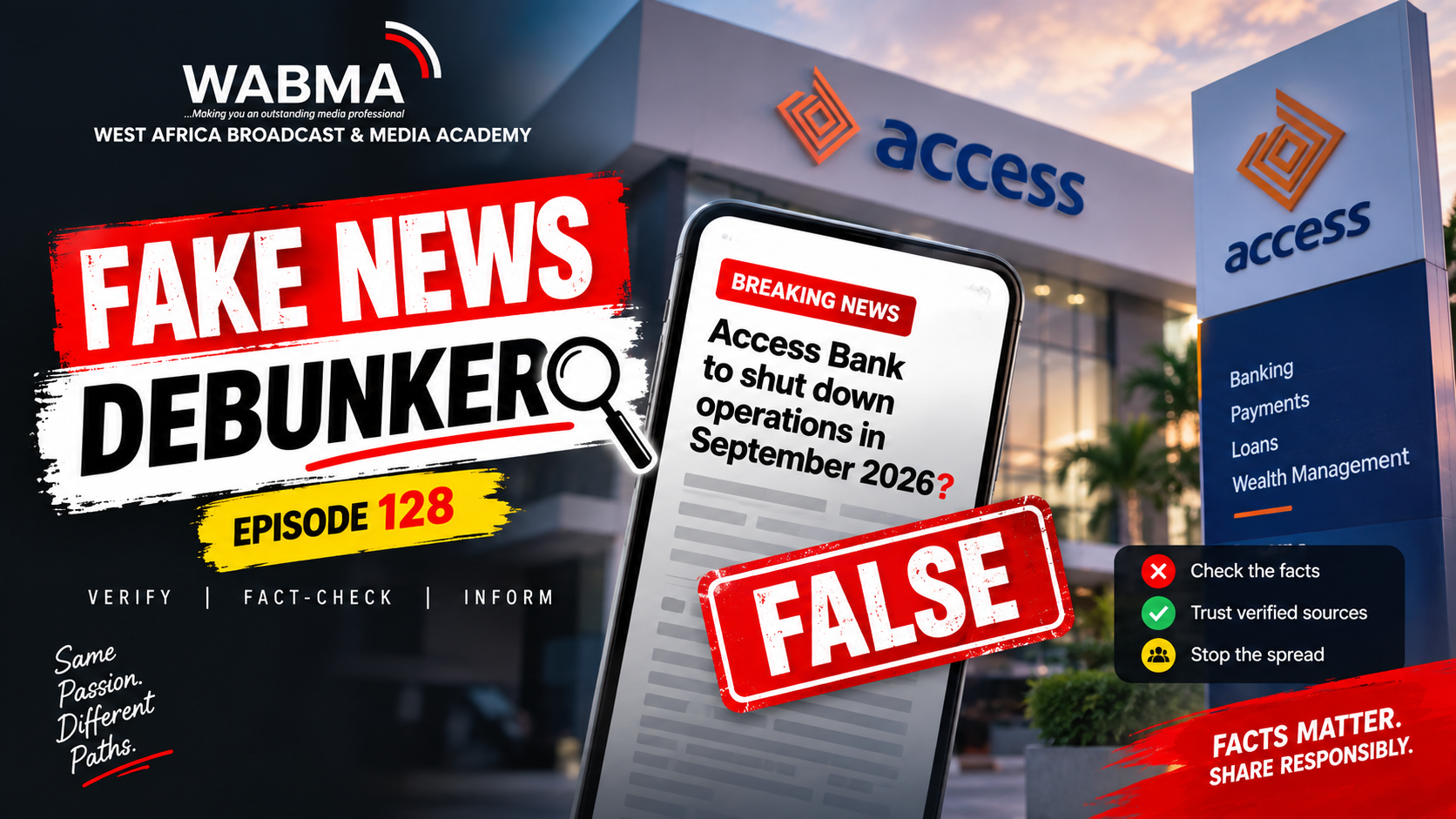
A message circulating on social media claims that Access Bank will shut down its banking operations in September 2026.
But is the claim true?
In Episode 128 of the WABMA Fake News Debunker, we examine the circulating message and verify the claim using statements from Access Bank, Access Holdings, and credible reports.
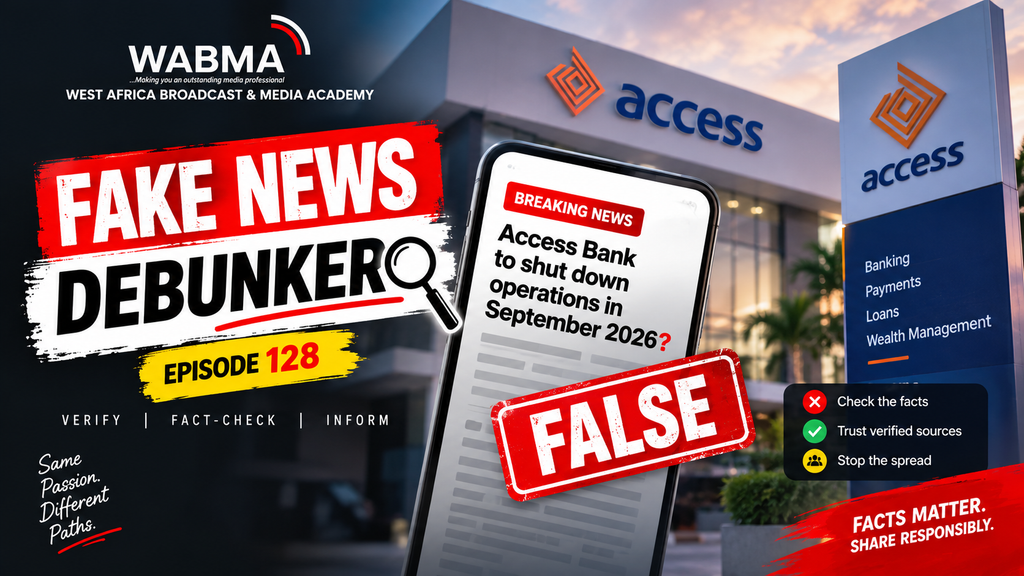
🔎 Verdict: FALSE
Access Bank has denied the circulating shutdown notice, describing it as false and misleading and stating that it impersonated the bank’s official communication channels.
Access Holdings also confirmed that the publication was false and unauthorised, stating that there had been no change to Access Bank’s operations or financial condition.
This episode highlights why it is important to verify financial information before sharing it or taking action based on it.
Watch Episode 128
🎥 Watch the full episode on YouTube:
WABMA Fake News Debunker – Episode 128
Have a claim you want us to fact-check?
📲 Send it to WABMA via WhatsApp: 0902 547 8072
📱 Social media: @wabmaonline | @wabmaacademy
Verify. Fact-check. Inform.
🌐 Visit: projectfactchecknigeria.org
#WABMA #FakeNewsDebunker #FactCheckNigeria #AccessBank #Misinformation #Nigeria

A series of images circulating across Facebook, Instagram, X, and WhatsApp appears to show women displaying underwear branded with the photograph of Kano State Governor Abba Yusuf.
The images sparked widespread reactions.
Some social media users accused the governor of turning empowerment programmes into political propaganda. Others mocked what they described as an unusual and inappropriate distribution of government items.
The photographs seemed convincing.

Women could be seen holding up underwear allegedly bearing the governor’s image during what appeared to be a public gathering.
But did the governor actually distribute such items?
WABMA Debunker investigated.
The first step was to determine where the images originated.
A reverse image search led investigators to a video posted by Kano-based influencer and political supporter Fatima Nasir, popularly known as “Teemah Cool.”
The original footage showed women displaying underwear during a political gathering.
But there was a crucial difference.

The underwear visible in the original video did not contain Governor Abba Yusuf’s photograph.
This raised an important question.
If the governor’s image was absent in the original footage, how did it suddenly appear in the viral pictures?
To answer this, further forensic analysis was conducted on the circulating images.
The findings were revealing.
Digital examination showed signs of image manipulation. Analysis using SynthID Verifier detected evidence that portions of the viral images had been edited and artificially generated.
The governor’s photograph appeared to have been digitally inserted into the underwear after the original footage was recorded.
In other words, the images circulating online were not an accurate representation of what participants displayed at the event.
Investigators also examined claims that the underwear formed part of an official empowerment programme sponsored by the Kano State Government.
No evidence was found to support this assertion.
There were no government announcements, policy documents, media briefings, or credible news reports indicating that such items were distributed as part of any state empowerment initiative.
Further checks showed that the original gathering was linked to a political event in Kano during a visit by Nigeria’s First Lady, Oluremi Tinubu.
Participants reportedly engaged in symbolic political displays connected to local political rivalries.
Nothing in the available evidence suggests that Governor Abba Yusuf authorized, distributed, or endorsed underwear bearing his image.
So what is really true here?
The gathering shown in the original footage did occur.
Women were seen displaying underwear during the event.
What did not occur was the distribution of underwear branded with Governor Abba Yusuf’s photograph.
That element was added later through digital manipulation.
VERDICT
FALSE.
There is no evidence that Kano State Governor Abba Yusuf distributed women’s underwear branded with his photograph as empowerment items.
The viral images were digitally altered, with the governor’s image inserted into the original footage after it was recorded.
WHY THIS MATTERS
Manipulated images can spread rapidly online and create false impressions about public officials, government programmes, and political events.
As election related discussions intensify across Nigeria, altered photographs and AI generated content are becoming increasingly common tools for misinformation.
Verifying the source of an image and examining whether it has been digitally modified remain essential steps before sharing sensitive political content.
CONCLUSION
The claim is False. Reverse image searches traced the content to an original video posted by influencer Fatima Nasir (“Teemah Cool”), where no governor’s image appeared on the underwear. Forensic analysis found evidence of digital manipulation, and no official government records or credible media reports support the claim.

Did Access Bank Announce It Will Shut Down Operations in September 2026?