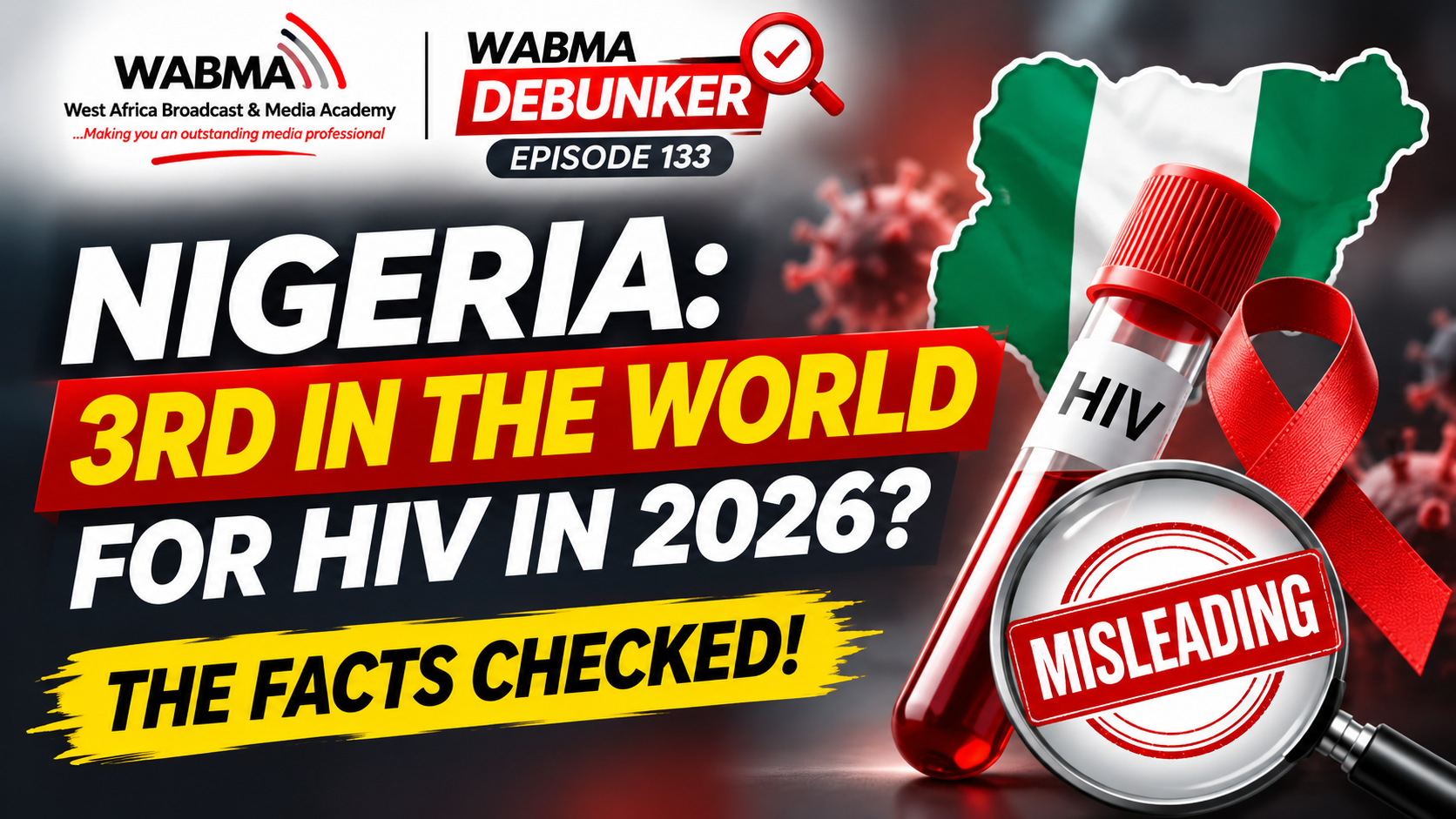
A graphic circulating on social media claims that Nigeria ranks third in the world for HIV, with about 1.7 to 1.9 million people living with HIV in 2026.
The graphic provides no source for the ranking.
Nigeria does have one of the world’s largest populations of people living with HIV.
But is Nigeria really number three in the world in 2026?
VERIFICATION
WABMA Debunker investigated.
First, there is an important distinction.
HIV burden can be measured in different ways.
One is HIV prevalence, meaning the proportion of a population living with HIV.
Another is the total number of people living with HIV.
These are not the same thing, and countries can rank very differently depending on which measure is being used.
We checked the latest data from UNAIDS, the United Nations programme responsible for coordinating the global response to HIV and AIDS.
And we found a problem with the viral claim.
The description of Nigeria as third in the world is largely based on an older ranking.
Nigeria was previously described as having the world’s third largest HIV burden, behind South Africa and India.
But that historical description should not automatically be presented as Nigeria’s current global position.
For example, South Africa alone had an estimated 7.8 million people living with HIV in 2024, according to UNAIDS. (UNAIDS)
Current UNAIDS datasets also show substantial HIV populations in countries including Mozambique, meaning a current global ranking needs to be calculated from comparable country data rather than copied from older reports. (AIDS Data Repository)
There is another problem with the viral graphic.
It describes 1.7 to 1.9 million people as Nigeria’s 2026 HIV figure.
That wording can be misleading.
UNAIDS released updated HIV estimates in July 2026, but those figures describe the HIV situation in 2025.
UNAIDS says that globally about 41 million people were living with HIV in 2025. (UNAIDS)
The UNAIDS data repository also identifies Nigeria’s “HIV Estimates 2026” dataset as containing estimates for the year 2025. (AIDS Data Repository)
So, a dataset released in 2026 should not automatically be described as the number of Nigerians who had HIV “in 2026.”
There is another language issue.
People living with HIV should not simply be described as “people infected in 2026.”
That wording can wrongly suggest that all of them acquired HIV during that year.
The correct expression is “people living with HIV.”
So, is the entire viral graphic false?
No.
The underlying point that Nigeria has a substantial HIV burden is true.
Nigeria has roughly two million people living with HIV according to recent estimates and remains one of the countries carrying a significant share of the global HIV burden.
But combining that fact with an outdated or unsupported global ranking makes the graphic misleading.
VERDICT: MISLEADING
The claim that Nigeria is currently the world’s third highest country for HIV cases in 2026 is MISLEADING.
Nigeria does have one of the world’s largest populations of people living with HIV.
But the “third in the world” description comes from older rankings and should not be presented as a confirmed 2026 global ranking without current comparable data.
The claim also confuses the year in which UNAIDS released its latest estimates with the year those estimates describe.
UNAIDS’ 2026 data release reports HIV estimates for 2025, not a final count of HIV cases occurring in 2026. (UNAIDS)
WHY THIS MATTERS
Health statistics require context.
A number may be genuine but still become misinformation when someone attaches the wrong year, ranking or description to it.
And when reporting HIV, we should distinguish between people living with HIV, new HIV infections and HIV prevalence.
They measure different things.
So when you see a health ranking online, do not just ask whether the number looks believable.
Ask where it came from, what exactly it measures and which year it represents.
Do you have a story? Tag us on all our socials @wabmaonline, or on Instagram @wabmaacademy. You can also share via WhatsApp on 0902 547 8072, and we will fact-check for you.
Before you share any claim — especially about politics — take a moment to verify. Visit WABMA Debunker weekly for verified stories that separate fact from fiction.
Join WABMA in debunking fake stories. Share this with your contacts.