Connect with us

News

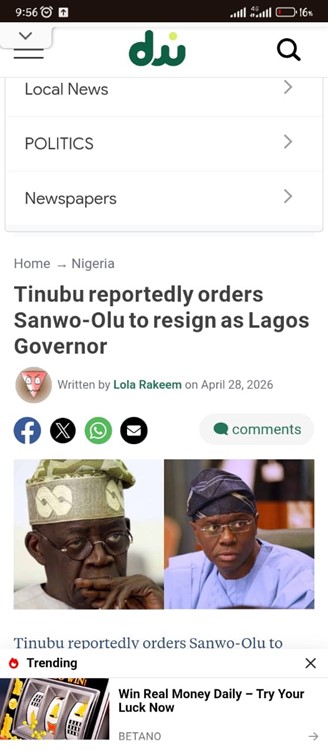
Did President Bola Tinubu Order Governor Babajide Sanwo-Olu To Resign?

Published

on

A report is spreading fast across social media.

It claims that Nigeria’s President, Bola Ahmed Tinubu, has ordered the Governor of Lagos State, Babajide Sanwo-Olu, to resign.
The reason? A serious health condition.

The claim has triggered concern, speculation, and heated discussions online.

But is this true? Or is this another case of misinformation dressed as breaking news?

[Context Setup]

The report gained traction on social media platforms and was amplified by blogs and online outlets, including Dockays World and Sahara Reporters.

According to the claim, Governor Sanwo-Olu is critically ill, and the President has directed him to step down.

Given the political weight of both figures, this is not a minor claim.

Babajide Sanwo-Olu has served as Lagos State Governor since 2019 and was re-elected in 2023.

Bola Ahmed Tinubu, a former Lagos Governor himself, assumed office as President in 2023.

So, a directive like this would be major national news.

We investigated.

[Verification Step 1: Health Claim]

First, we examined the claim that the governor is seriously ill.

There are no credible reports from verified medical, government, or reputable media sources indicating that Governor Sanwo-Olu is suffering from any critical illness.

But we went further.

[Verification Step 2: Public Activity Check]

We reviewed the governor’s recent public engagements.

Here is what we found:

  • On April 24, he swore in Permanent Secretaries and inaugurated the Lagos State Health Service Commission
  • He attended a Governance Advisory Council meeting at Lagos House
  • On April 26, he witnessed the signing of power purchase agreements
  • On April 28, he was inducted into the Chartered Institute of Stockbrokers

These are not the activities of someone incapacitated by serious illness.

They indicate active governance.

[Verification Step 3: Official Communication]

Next, we checked for official confirmation.

There is:

  • No statement from the Presidency
  • No communication from the Lagos State Government
  • No directive from any federal authority

For a claim of this magnitude, silence from official channels is a major red flag.

[Verification Step 4: Direct Response]

We then checked for direct responses.

The Lagos State Government has publicly addressed the claim.

The governor’s media aide, Gboyega Akosile, described the report as false and misleading.

This is a clear denial from an official source.

[Verification Step 5: Media Cross-Check]

Finally, we reviewed coverage by major Nigerian media organisations.

Reputable outlets did not report this claim.

In journalism, absence of coverage by credible media—especially on a major political development—is significant.

It suggests the story lacks verification.

[Evidence Reveal]

So far:

  • No credible evidence of illness
  • Active public engagements by the governor
  • No official directive from the President
  • Direct denial from the Lagos State Government
  • No confirmation from credible media

The pieces do not support the claim.
[Verdict]

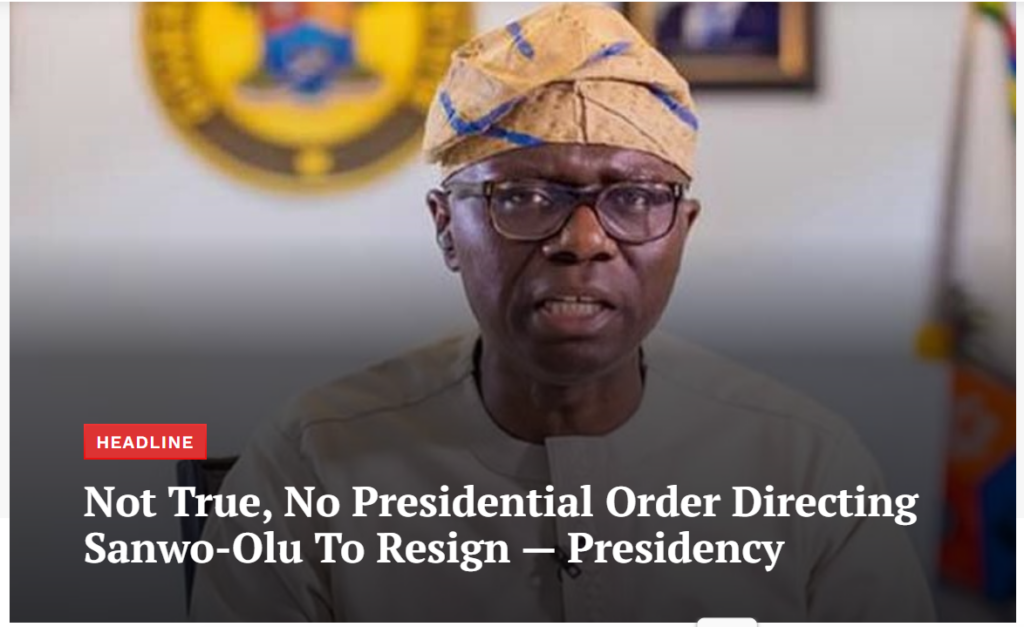
FALSE

There is no evidence that Bola Ahmed Tinubu ordered Babajide Sanwo-Olu to resign. The report is based on unverified claims and has been amplified without credible backing.

Available evidence shows that the governor is actively performing his duties, and the Lagos State Government has already dismissed the claim as false.

Did Tinubu Order Sanwo-Olu To Resign? | Fact-Check & Debunk Explained

Always fact-check before you share. Don’t engage. Don’t amplify.

Do you have a story? Tag us on all our socials @wabmaonline, or on Instagram @wabmaacademy. You can also share via WhatsApp on 0902 547 8072, and we will fact-check for you.

Before you share any claim — especially about politics — take a moment to verify. Visit WABMA Debunker weekly for verified stories that separate fact from fiction.

Join WABMA in debunking fake stories. Share this with your contacts.

My name is [Presenter’s Name]. Thank you for listening.
Continue Reading
Click to comment

Leave a Reply

Your email address will not be published. Required fields are marked *

News

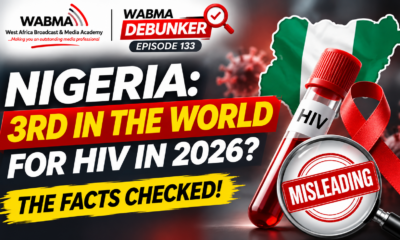
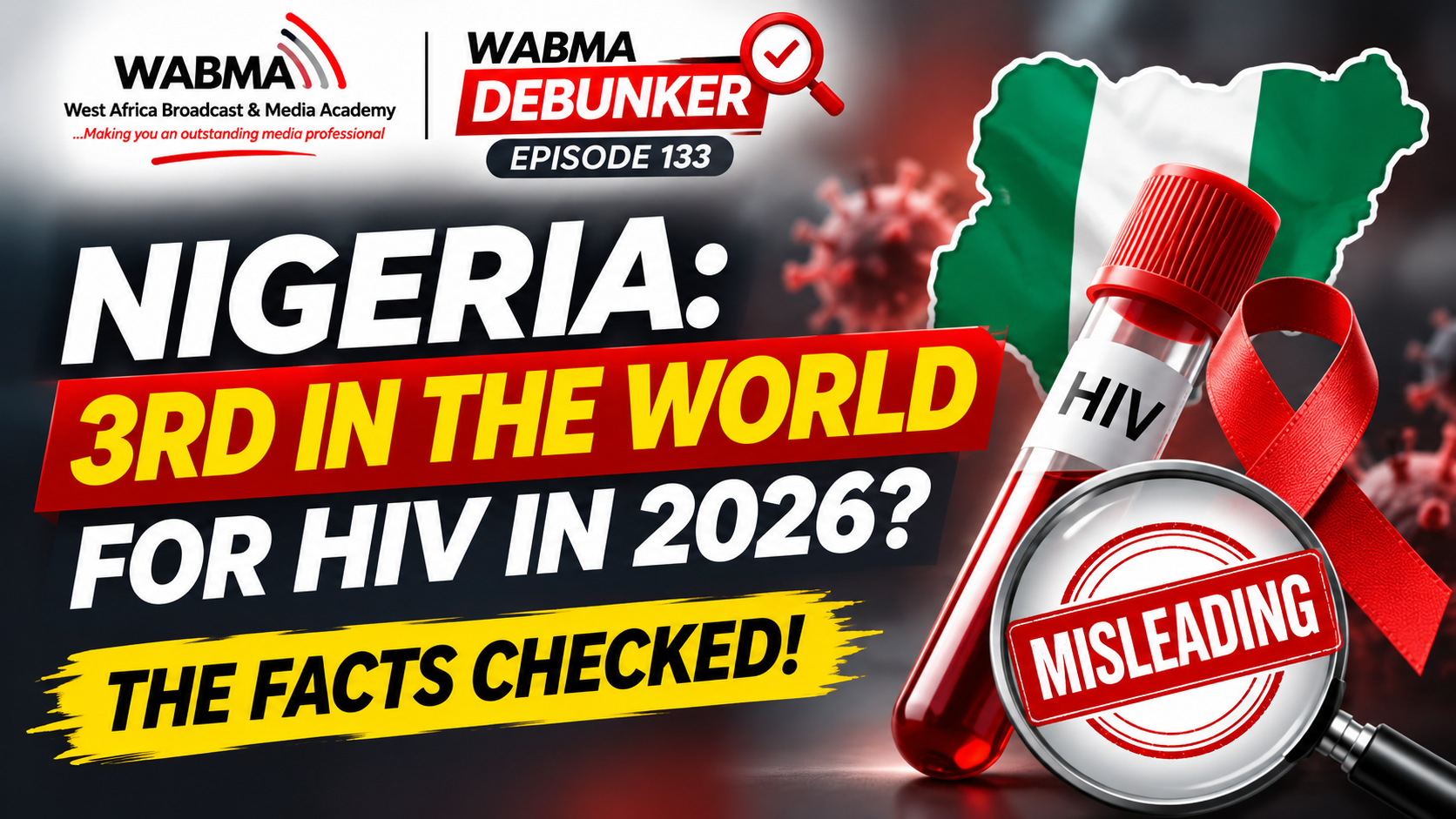
💥 Is Nigeria 3rd in the World for HIV in 2026? | MISLEADING

Published

on

💥 Is Nigeria 3rd in the World for HIV in 2026? | MISLEADING

🎥 Watch the full episode: 👇
https://youtu.be/TEgypvthfPc.co

Watch, like & subscribe!🙏🏽

WABMA, in collaboration with media professionals, continues the fight against fake news and misinformation across social and traditional media.

🔎 Verify before you share.
🌐 FMI: projectfactchecknigeria.org

#WABMA #FakeNewsDebunker #WABMADebunker #HIVFactCheck #StopMisinformation

Continue Reading

News

Is Nigeria the World’s Third Highest Country for HIV Cases in 2026?

Published

on

A graphic circulating on social media claims that Nigeria ranks third in the world for HIV, with about 1.7 to 1.9 million people living with HIV in 2026.

The graphic provides no source for the ranking.

Nigeria does have one of the world’s largest populations of people living with HIV.

But is Nigeria really number three in the world in 2026?

VERIFICATION

WABMA Debunker investigated.

First, there is an important distinction.

HIV burden can be measured in different ways.

One is HIV prevalence, meaning the proportion of a population living with HIV.

Another is the total number of people living with HIV.

These are not the same thing, and countries can rank very differently depending on which measure is being used.

We checked the latest data from UNAIDS, the United Nations programme responsible for coordinating the global response to HIV and AIDS.

And we found a problem with the viral claim.

The description of Nigeria as third in the world is largely based on an older ranking.

Nigeria was previously described as having the world’s third largest HIV burden, behind South Africa and India.

But that historical description should not automatically be presented as Nigeria’s current global position.

For example, South Africa alone had an estimated 7.8 million people living with HIV in 2024, according to UNAIDS. (UNAIDS)

Current UNAIDS datasets also show substantial HIV populations in countries including Mozambique, meaning a current global ranking needs to be calculated from comparable country data rather than copied from older reports. (AIDS Data Repository)

There is another problem with the viral graphic.

It describes 1.7 to 1.9 million people as Nigeria’s 2026 HIV figure.

That wording can be misleading.

UNAIDS released updated HIV estimates in July 2026, but those figures describe the HIV situation in 2025.

UNAIDS says that globally about 41 million people were living with HIV in 2025. (UNAIDS)

The UNAIDS data repository also identifies Nigeria’s “HIV Estimates 2026” dataset as containing estimates for the year 2025. (AIDS Data Repository)

So, a dataset released in 2026 should not automatically be described as the number of Nigerians who had HIV “in 2026.”

There is another language issue.

People living with HIV should not simply be described as “people infected in 2026.”

That wording can wrongly suggest that all of them acquired HIV during that year.

The correct expression is “people living with HIV.”

So, is the entire viral graphic false?

No.

The underlying point that Nigeria has a substantial HIV burden is true.

Nigeria has roughly two million people living with HIV according to recent estimates and remains one of the countries carrying a significant share of the global HIV burden.

But combining that fact with an outdated or unsupported global ranking makes the graphic misleading.

VERDICT: MISLEADING

The claim that Nigeria is currently the world’s third highest country for HIV cases in 2026 is MISLEADING.

Nigeria does have one of the world’s largest populations of people living with HIV.

But the “third in the world” description comes from older rankings and should not be presented as a confirmed 2026 global ranking without current comparable data.

The claim also confuses the year in which UNAIDS released its latest estimates with the year those estimates describe.

UNAIDS’ 2026 data release reports HIV estimates for 2025, not a final count of HIV cases occurring in 2026. (UNAIDS)

WHY THIS MATTERS

Health statistics require context.

A number may be genuine but still become misinformation when someone attaches the wrong year, ranking or description to it.

And when reporting HIV, we should distinguish between people living with HIV, new HIV infections and HIV prevalence.

They measure different things.

So when you see a health ranking online, do not just ask whether the number looks believable.

Ask where it came from, what exactly it measures and which year it represents.

Do you have a story? Tag us on all our socials @wabmaonline, or on Instagram @wabmaacademy. You can also share via WhatsApp on 0902 547 8072, and we will fact-check for you.

Before you share any claim — especially about politics — take a moment to verify. Visit WABMA Debunker weekly for verified stories that separate fact from fiction.

Join WABMA in debunking fake stories. Share this with your contacts.

Continue Reading

News

Did Nigeria launch FreeTV nationwide?

Published

on

A message circulating on WhatsApp claims that the Federal Government of Nigeria has launched FreeTV nationwide, giving Nigerians access to more than 100 television channels without paying monthly subscription fees.

Some social media users have questioned the claim, asking whether FreeTV is real or simply another viral internet message.

So, did Nigeria actually launch FreeTV nationwide?

VERIFICATION

WABMA Debunker checked the claim.

Our findings show that the claim is TRUE.

On June 17, 2026, the Federal Government launched FreeTV, a national digital television platform under Nigeria’s Digital Switch Over programme. Independent reports from Premium Times, The Guardian and other Nigerian media confirm the launch.

FreeTV is part of Nigeria’s long running transition from analogue television broadcasting to digital broadcasting.

According to the official FreeTV platform, viewers can access more than 100 national, regional and state television channels without paying monthly subscription fees.

The available programming includes news, sports, movies and Nollywood, entertainment, children’s programmes, educational content and regional language channels.

FreeTV says its satellite service provides coverage across all 36 states. The service can also be accessed through terrestrial broadcasting and the FreeTV mobile application.

But there is an important clarification.

FreeTV does not mean that everything required to watch it is provided free of charge.

There are no monthly subscription charges, but television viewers may need compatible reception equipment.

The official FreeTV website lists a free to air DVB S2 decoder, a satellite dish and an LNB among the equipment required for satellite reception. Compatible DVB T2 or DVB S2 decoders may also be used.

In other words, you may have to spend money to get connected, but once properly connected, you do not pay a monthly television subscription.

VERDICT: TRUE

The Federal Government of Nigeria launched FreeTV on June 17, 2026, as part of the country’s Digital Switch Over programme.

The platform offers more than 100 channels without monthly subscription charges and has nationwide satellite coverage.

So, if you received the message saying Nigeria has launched FreeTV nationwide, the central claim is true.

But remember: no monthly subscription does not necessarily mean no cost of equipment or installation.

Continue Reading

Trending