Connect with us

News

Was the only survivor in the recent Air India crash arrested?

Published

on

It was one of the worst aviation disasters in recent Indian history.


An Air India Dreamliner crashed shortly after takeoff on June 12, 2025, from Ahmedabad, Gujarat, killing over 270 people. The world mourned. Families grieved. News outlets ran 24-hour coverage. And then, about a week later, another story began to surface online.

This time, it wasn’t about tragedy. It was about deception.
A video posted by an Instagram account named @aviationspotting7 claimed that the crash’s lone survivor, a man named Vishwas Ramesh Kumar, had been arrested for faking his presence on the flight.

The voiceover was calm but accusing. It claimed that Kumar was nowhere on the passenger manifest, He had been caught on CCTV at a local shopping mall during the time of the crash, and had lied to gain compensation or media attention.

The caption was damning:
“Truth revealed: Survivor of Air India crash arrested for falsely claiming to be on board.”

The video was shared widely on Instagram and WhatsApp. Hashtags like #TruthRevealed, #AirIndiaCrash, and #FakeSurvivor added fuel.

People were outraged. They accused Kumar of exploiting the deaths of 270 people. Some demanded he be jailed. Others doubted there had been any survivor at all.

But let’s pause. Because there’s a problem with this story.
Actually, several.

First, no credible Indian news outlet reported Kumar’s arrest. That’s unusual, especially given the intense local and international coverage surrounding the crash.
Second, when journalists reached out directly to law enforcement, they got a very different account.
Jaipal Singh Rathore, Additional Commissioner of Police in Ahmedabad, was unequivocal:

“Mr. Vishwas Ramesh Kumar has not been arrested. He is not under investigation for any such claim.”

In fact, police confirmed that Kumar was onboard the doomed flight. He survived—barely—and was treated at Ahmedabad Civil Hospital for multiple injuries.

So why the confusion?
Investigators believe Kumar’s survival was due to sheer luck—and seat location. He was seated near an emergency exit, which may have allowed him to escape during the crash’s brief but devastating window.
Following his discharge, Kumar even attended the funeral rites of his brother — one of the victims who perished in the crash. Photos showed him visibly shaken, standing beside grieving relatives.
None of this matches the image painted in the viral video.

So where did that narrative come from?

While it’s unclear who produced the false video, analysts point to a growing trend of AI-generated disinformation. With just a few clips, stock footage, and a synthesized voiceover, anyone can manufacture an alternate reality — one that looks real and spreads fast.

But the damage is also real.
Kumar, already a survivor of a traumatic event, had his name dragged through the mud. He was accused, insulted, and questioned — not for what he did, but for what someone said he did.

The verdict: The claim is FALSE. Kumar was not arrested. He survived the crash. He never lied.
What happened to him was not fraud. It was survival.
And once again, the internet proved that a lie told well can still outrun the truth — unless someone stops to check.
That’s what we do here at WABMA Debunker.

Continue Reading
Click to comment

Leave a Reply

Your email address will not be published. Required fields are marked *

News

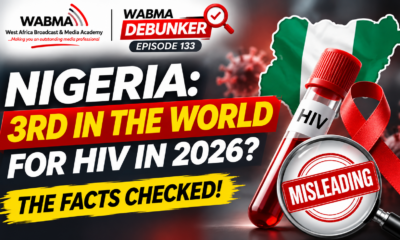
💥 Is Nigeria 3rd in the World for HIV in 2026? | MISLEADING

Published

on

💥 Is Nigeria 3rd in the World for HIV in 2026? | MISLEADING

🎥 Watch the full episode: 👇
https://youtu.be/TEgypvthfPc.co

Watch, like & subscribe!🙏🏽

WABMA, in collaboration with media professionals, continues the fight against fake news and misinformation across social and traditional media.

🔎 Verify before you share.
🌐 FMI: projectfactchecknigeria.org

#WABMA #FakeNewsDebunker #WABMADebunker #HIVFactCheck #StopMisinformation

Continue Reading

News

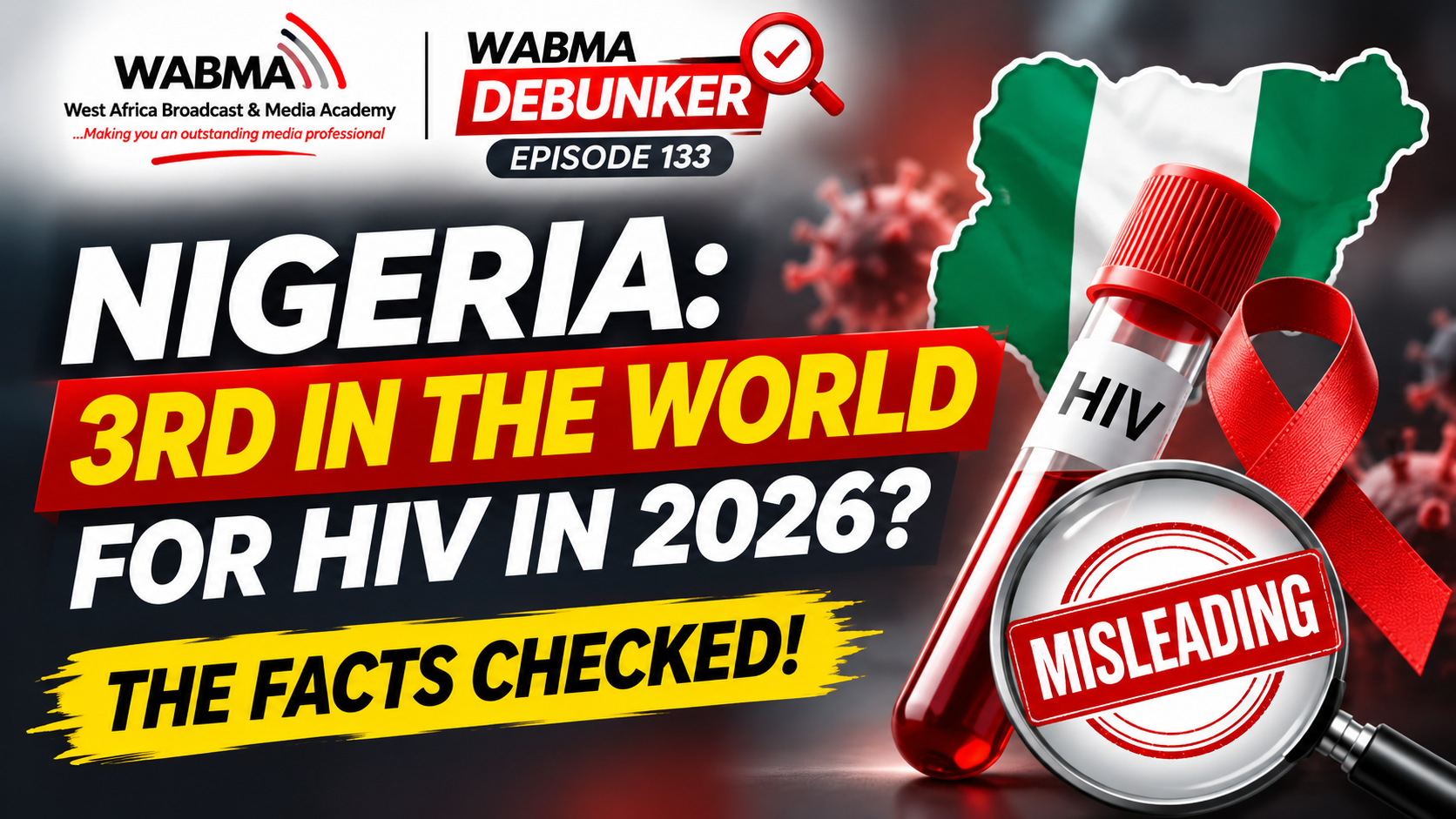
Is Nigeria the World’s Third Highest Country for HIV Cases in 2026?

Published

on

A graphic circulating on social media claims that Nigeria ranks third in the world for HIV, with about 1.7 to 1.9 million people living with HIV in 2026.

The graphic provides no source for the ranking.

Nigeria does have one of the world’s largest populations of people living with HIV.

But is Nigeria really number three in the world in 2026?

VERIFICATION

WABMA Debunker investigated.

First, there is an important distinction.

HIV burden can be measured in different ways.

One is HIV prevalence, meaning the proportion of a population living with HIV.

Another is the total number of people living with HIV.

These are not the same thing, and countries can rank very differently depending on which measure is being used.

We checked the latest data from UNAIDS, the United Nations programme responsible for coordinating the global response to HIV and AIDS.

And we found a problem with the viral claim.

The description of Nigeria as third in the world is largely based on an older ranking.

Nigeria was previously described as having the world’s third largest HIV burden, behind South Africa and India.

But that historical description should not automatically be presented as Nigeria’s current global position.

For example, South Africa alone had an estimated 7.8 million people living with HIV in 2024, according to UNAIDS. (UNAIDS)

Current UNAIDS datasets also show substantial HIV populations in countries including Mozambique, meaning a current global ranking needs to be calculated from comparable country data rather than copied from older reports. (AIDS Data Repository)

There is another problem with the viral graphic.

It describes 1.7 to 1.9 million people as Nigeria’s 2026 HIV figure.

That wording can be misleading.

UNAIDS released updated HIV estimates in July 2026, but those figures describe the HIV situation in 2025.

UNAIDS says that globally about 41 million people were living with HIV in 2025. (UNAIDS)

The UNAIDS data repository also identifies Nigeria’s “HIV Estimates 2026” dataset as containing estimates for the year 2025. (AIDS Data Repository)

So, a dataset released in 2026 should not automatically be described as the number of Nigerians who had HIV “in 2026.”

There is another language issue.

People living with HIV should not simply be described as “people infected in 2026.”

That wording can wrongly suggest that all of them acquired HIV during that year.

The correct expression is “people living with HIV.”

So, is the entire viral graphic false?

No.

The underlying point that Nigeria has a substantial HIV burden is true.

Nigeria has roughly two million people living with HIV according to recent estimates and remains one of the countries carrying a significant share of the global HIV burden.

But combining that fact with an outdated or unsupported global ranking makes the graphic misleading.

VERDICT: MISLEADING

The claim that Nigeria is currently the world’s third highest country for HIV cases in 2026 is MISLEADING.

Nigeria does have one of the world’s largest populations of people living with HIV.

But the “third in the world” description comes from older rankings and should not be presented as a confirmed 2026 global ranking without current comparable data.

The claim also confuses the year in which UNAIDS released its latest estimates with the year those estimates describe.

UNAIDS’ 2026 data release reports HIV estimates for 2025, not a final count of HIV cases occurring in 2026. (UNAIDS)

WHY THIS MATTERS

Health statistics require context.

A number may be genuine but still become misinformation when someone attaches the wrong year, ranking or description to it.

And when reporting HIV, we should distinguish between people living with HIV, new HIV infections and HIV prevalence.

They measure different things.

So when you see a health ranking online, do not just ask whether the number looks believable.

Ask where it came from, what exactly it measures and which year it represents.

Do you have a story? Tag us on all our socials @wabmaonline, or on Instagram @wabmaacademy. You can also share via WhatsApp on 0902 547 8072, and we will fact-check for you.

Before you share any claim — especially about politics — take a moment to verify. Visit WABMA Debunker weekly for verified stories that separate fact from fiction.

Join WABMA in debunking fake stories. Share this with your contacts.

Continue Reading

News

Did Nigeria launch FreeTV nationwide?

Published

on

A message circulating on WhatsApp claims that the Federal Government of Nigeria has launched FreeTV nationwide, giving Nigerians access to more than 100 television channels without paying monthly subscription fees.

Some social media users have questioned the claim, asking whether FreeTV is real or simply another viral internet message.

So, did Nigeria actually launch FreeTV nationwide?

VERIFICATION

WABMA Debunker checked the claim.

Our findings show that the claim is TRUE.

On June 17, 2026, the Federal Government launched FreeTV, a national digital television platform under Nigeria’s Digital Switch Over programme. Independent reports from Premium Times, The Guardian and other Nigerian media confirm the launch.

FreeTV is part of Nigeria’s long running transition from analogue television broadcasting to digital broadcasting.

According to the official FreeTV platform, viewers can access more than 100 national, regional and state television channels without paying monthly subscription fees.

The available programming includes news, sports, movies and Nollywood, entertainment, children’s programmes, educational content and regional language channels.

FreeTV says its satellite service provides coverage across all 36 states. The service can also be accessed through terrestrial broadcasting and the FreeTV mobile application.

But there is an important clarification.

FreeTV does not mean that everything required to watch it is provided free of charge.

There are no monthly subscription charges, but television viewers may need compatible reception equipment.

The official FreeTV website lists a free to air DVB S2 decoder, a satellite dish and an LNB among the equipment required for satellite reception. Compatible DVB T2 or DVB S2 decoders may also be used.

In other words, you may have to spend money to get connected, but once properly connected, you do not pay a monthly television subscription.

VERDICT: TRUE

The Federal Government of Nigeria launched FreeTV on June 17, 2026, as part of the country’s Digital Switch Over programme.

The platform offers more than 100 channels without monthly subscription charges and has nationwide satellite coverage.

So, if you received the message saying Nigeria has launched FreeTV nationwide, the central claim is true.

But remember: no monthly subscription does not necessarily mean no cost of equipment or installation.

Continue Reading

Trending